
For Venture Capital
Portfolio data without the quarterly shakedown.
Founders send what they have, in whatever shape they have it. FactorIQ normalizes it into the metrics you actually track — ARR, retention, burn, runway, ownership — so your portfolio review isn't hostage to the last three companies that haven't replied.
What breaks today
Three failures that turn a portfolio review into a collection project.
Failure 01
Chasing the update.
Quarterly collection is a manual campaign, and the companies you most want numbers from are the ones with the least time to send them. The review slips because a handful of founders went quiet.
Failure 02
Every founder's own format.
One sends a Notion page, one sends a spreadsheet, one drops it in Slack. Someone on your team turns all of it into comparable numbers by hand, every single quarter.
Failure 03
Reserve calls on stale inputs.
Follow-on decisions get made against data that was already a quarter old the day it arrived — right when a mispriced reserve costs the most.
The loop, for a venture fund
Sourcing, diligence, and portfolio review on one continuous surface.
Stage 01
Discover
Source and track opportunities against your thesis with Deal Finder — sector, stage, and traction signals — so the top of your funnel is scored, not just a spreadsheet of intros.
Stage 02
Diligence
Read the data room fast with Investment Screening: the AI parses the deck, the metrics, and the customer references, so first partner meetings start from analysis instead of a cold read.
Stage 03
Monitor
One normalized view of every company — ARR, net revenue retention, burn multiple, runway, and ownership across rounds — refreshed as updates land. Daily AI Review is the Monday-morning read: which companies changed, whose runway shortened, and where a follow-on window is opening, synthesized before anyone opens the platform.
The seam nobody owns
Collection is solved. Synthesis isn't.
The modern venture stack already has a category for metric collection, a category for reserve modeling and fund construction, and a category for relationship CRM. Each of them does its job well.
What the stack doesn't have is the thing that tells you, on a Monday morning, what changed across all three at once — the company whose net revenue retention just re-rated, whose reserve is now under-sized, and whom the general partner had coffee with last week. That sentence lives in three systems and nowhere in one.
Daily AI Review is that layer. It reads across your collected metrics, your reserve model, and your relationship history, and produces the paragraph a partner would have written if they'd had four uninterrupted hours over the weekend.
Portfolio review
The portfolio and its Monday synthesis, side by side.
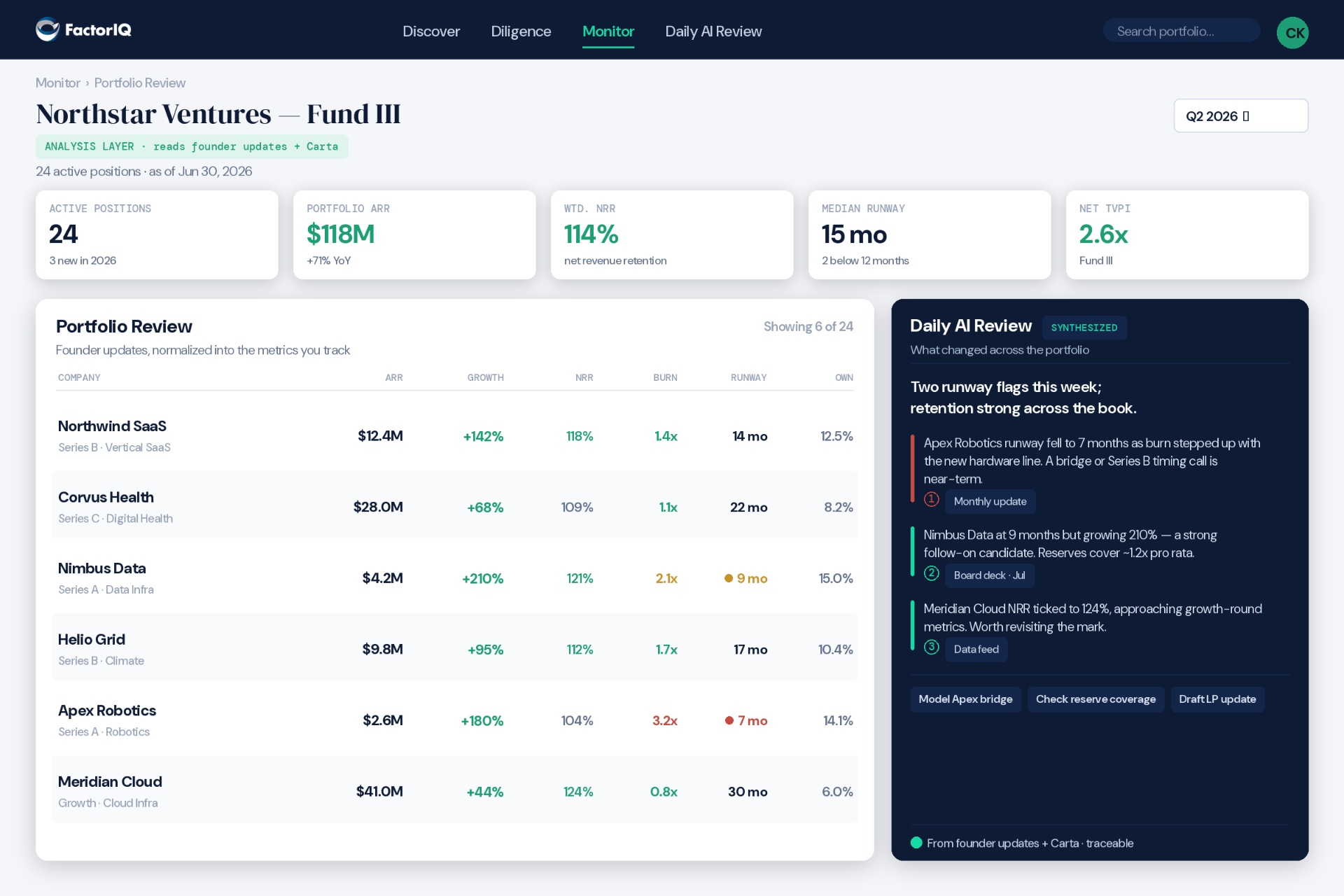
- 1
The morning synthesis: "Two runway flags this week; retention strong across the book" — the paragraph a partner would have written, generated before the platform opens.
- 2
Runway and burn flag: Apex Robotics at 7 months of cash with a 3.2x burn multiple, surfaced against the reserve plan for that position.
- 3
Net revenue retention movement: Meridian Cloud NRR ticked to 124%, approaching growth-round metrics and changing the mark story before the round dynamics do.
What FactorIQ tracks for venture
Company operating truth, ownership math, and fund-level performance.
| Category | What it covers |
|---|---|
| Company level | ARR and growth rate, net and gross revenue retention, burn multiple, runway, magic number, CAC payback, and headcount — normalized across every founder update. |
| Ownership | Entry and current ownership, dilution across rounds, pro rata rights, and reserve coverage for each position. |
| Fund level | TVPI, DPI, gross and net multiple, ownership-weighted exposure, and reserves deployed versus remaining dry powder. |
| Valuation | Mark-to-market and 409A context, with SAFEs and converted notes carried through to fully-diluted ownership. |
Category
Company level
What it covers
ARR and growth rate, net and gross revenue retention, burn multiple, runway, magic number, CAC payback, and headcount — normalized across every founder update.
Category
Ownership
What it covers
Entry and current ownership, dilution across rounds, pro rata rights, and reserve coverage for each position.
Category
Fund level
What it covers
TVPI, DPI, gross and net multiple, ownership-weighted exposure, and reserves deployed versus remaining dry powder.
Category
Valuation
What it covers
Mark-to-market and 409A context, with SAFEs and converted notes carried through to fully-diluted ownership.
Design partner program
We're building the venture view against real books of companies, with the platform leads who spend a week each quarter turning founder updates into comparable numbers.
Named funds arrive as the program does. Learn about the Design Partner Program →
What this sits alongside
Works alongside the venture stack you already run.
FactorIQ reads from your cap table provider (Carta, Pulley, AngelList), your CRM (Affinity, Attio, Salesforce), and your fund administrator — it normalizes what founders send and synthesizes across your tools; it doesn't replace them.
"Everyone can tell you a company's numbers. FactorIQ tells you which ones changed, and what to do about it."
See your portfolio the way your team wishes it looked.
A 30-minute walkthrough using your companies, your metrics, and your reserve model.
Request a demo