
Family Offices
Keep your reporting platform. Add the analysis layer.
FactorIQ isn't another system of record. It reads from the platform you already run and answers the questions it was never built to answer — about pacing, look-through exposure, and what the underlying companies are actually doing.
What breaks today
Three gaps the reporting platform was never designed to close.
Gap 01
Commitments in a spreadsheet.
The reporting platform holds positions. The commitment schedule, unfunded exposure, and pacing model live in a workbook next to it — usually owned by one person, updated after every capital-call notice, and reconciled to the platform by hand at quarter-end.
Gap 02
No look-through.
You can see the fund mark. You cannot see what the companies inside it are doing, and neither can the manager's quarterly letter, in any useful detail. A concentrated exposure to a single end market can build up across four funds and never appear on any single page.
Gap 03
Directs handled differently from funds.
Co-investments and direct holdings run on a separate process from fund commitments — different files, different owners, different review cadence — so no view covers both. The principal ends up reading two documents to answer one question.
The loop, for a family office
Manager selection, direct deals, and portfolio oversight in one surface.
Stage 01
Discover
Manager sourcing and direct-deal flow filtered against the family's mandate — vintage pacing, sector tilt, geography, and the co-investment rights already negotiated.
Stage 02
Diligence
Manager underwriting, direct-deal review, and co-investment memos in one workspace — with the fund's prior-vintage performance, the deck, and the reference calls already synthesized before the investment-committee meeting.
Stage 03
Monitor
Continuous view across fund commitments and directs — pacing against target, look-through exposure by manager and sector, capital-call and distribution schedule, and the operating businesses beneath every mark.
The analysis layer
Pacing, look-through, and directs on one page.
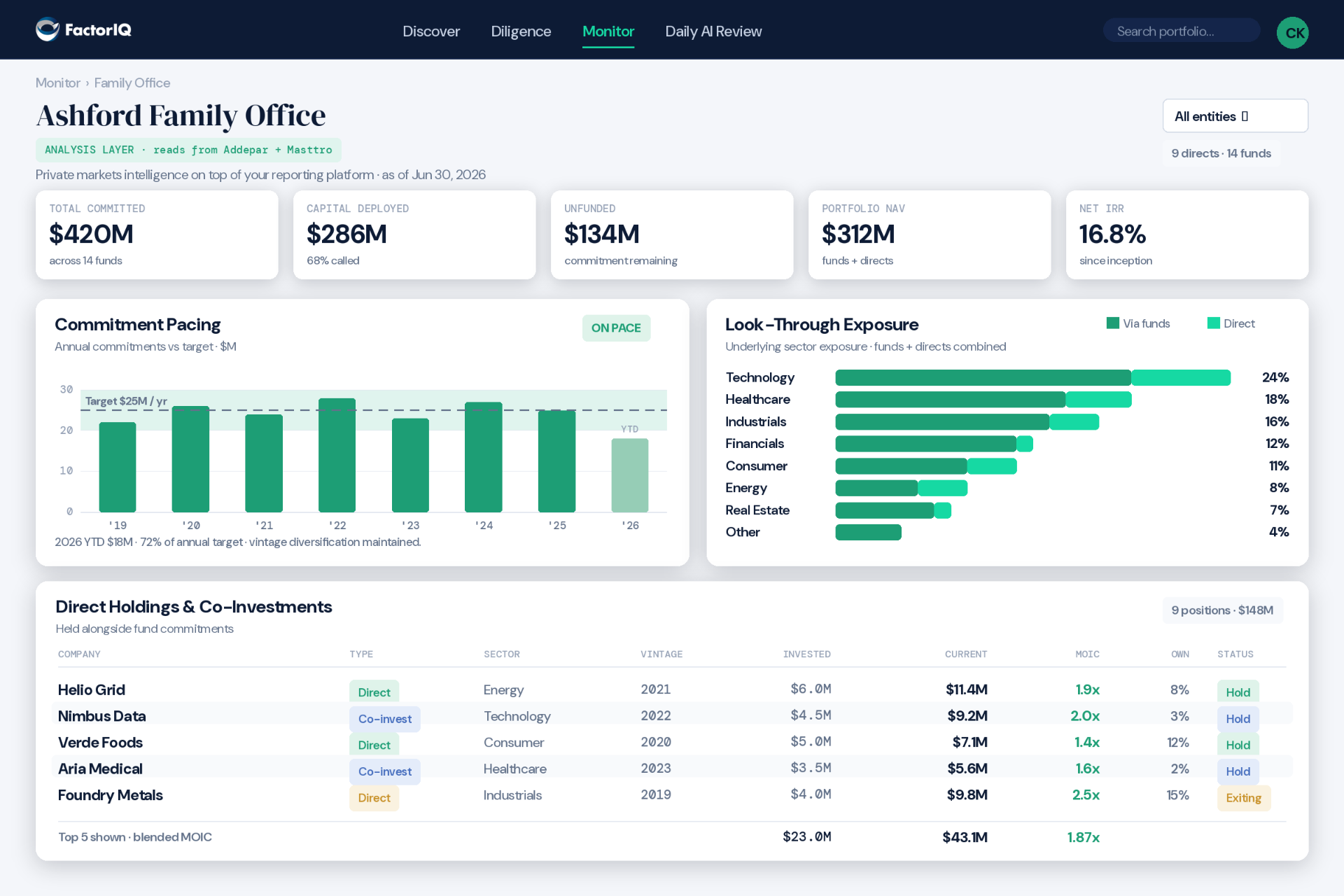
- 1
Commitment pacing — annual commitments vs target, with 2026 YTD progress and vintage diversification maintained.
- 2
Look-through exposure rolled up across every fund and direct holding — the concentrated sector that no single manager letter would surface.
- 3
Direct and co-investment holdings sitting in the same view as fund positions — one page instead of two.
What the platform computes
The measures a CIO uses to run pacing, exposure, and manager re-ups.
| Metric | How it's computed |
|---|---|
| Committed, called, distributed, unfunded | The four numbers that describe every commitment, refreshed from the capital-call and distribution notices as they arrive. |
| DPI, RVPI, TVPI, net IRR | By vintage and by manager, computed net of fees and carry, reconciled to the reporting platform. |
| Pacing against target allocation | Committed and expected-called capital against the family's private-markets target, projected forward on the pacing model. |
| Look-through sector exposure | Underlying company holdings rolled up by sector and sub-sector, aggregated across every manager the family is invested with. |
| Look-through geography exposure | Underlying revenue exposure by region, so a European tilt built up across four funds becomes a single number. |
| Direct holding performance | Company-level P&L, KPI progression, and value drivers for co-investments and directly-held operating businesses, in the same view as the fund positions. |
Metric
Committed, called, distributed, unfunded
How it's computed
The four numbers that describe every commitment, refreshed from the capital-call and distribution notices as they arrive.
Metric
DPI, RVPI, TVPI, net IRR
How it's computed
By vintage and by manager, computed net of fees and carry, reconciled to the reporting platform.
Metric
Pacing against target allocation
How it's computed
Committed and expected-called capital against the family's private-markets target, projected forward on the pacing model.
Metric
Look-through sector exposure
How it's computed
Underlying company holdings rolled up by sector and sub-sector, aggregated across every manager the family is invested with.
Metric
Look-through geography exposure
How it's computed
Underlying revenue exposure by region, so a European tilt built up across four funds becomes a single number.
Metric
Direct holding performance
How it's computed
Company-level P&L, KPI progression, and value drivers for co-investments and directly-held operating businesses, in the same view as the fund positions.
Design Partner Program
We're taking on a small number of family office design partners in 2026.
The family office configuration is being built in the open with a founding cohort. Partners are chosen for the shape of the portfolio, not the size of it.
Benefit 01
Direct input on the configuration.
How pacing is modeled, how look-through is aggregated, and how directs sit alongside funds are decisions made with partners, not shipped at them.
Benefit 02
Preferential terms.
Founding-cohort pricing that persists through the first published release, with the terms written up front.
Benefit 03
A direct line to the product team.
A named engineer and product lead on every partner engagement — not a ticketing queue.
What this sits alongside
Sits on top of your reporting platform. Reads from the tools you already pay for.
FactorIQ sits on top of Addepar, Masttro, Archway, or whatever holds your canonical positions. It reads from Arch and Canoe where those are in place, and from custodian and administrator feeds where they aren't. Nothing gets migrated. The reporting platform stays authoritative for positions and valuations — FactorIQ turns what it holds into pacing, exposure, and operating answers.
FactorIQ also works alongside the family's accounting and tax advisors rather than duplicating them. Partnership tax reporting, entity-level accounting, and filing workflows stay with the CPAs and the outsourced-CFO practice — FactorIQ does not touch that work.
See it against your own commitments and directs.
A 30-minute walkthrough using your pacing model, your manager list, and your co-investment holdings.
Request a demo